How to Stay Focused and Avoid Distractions

How to Stay Focused and Avoid Distractions
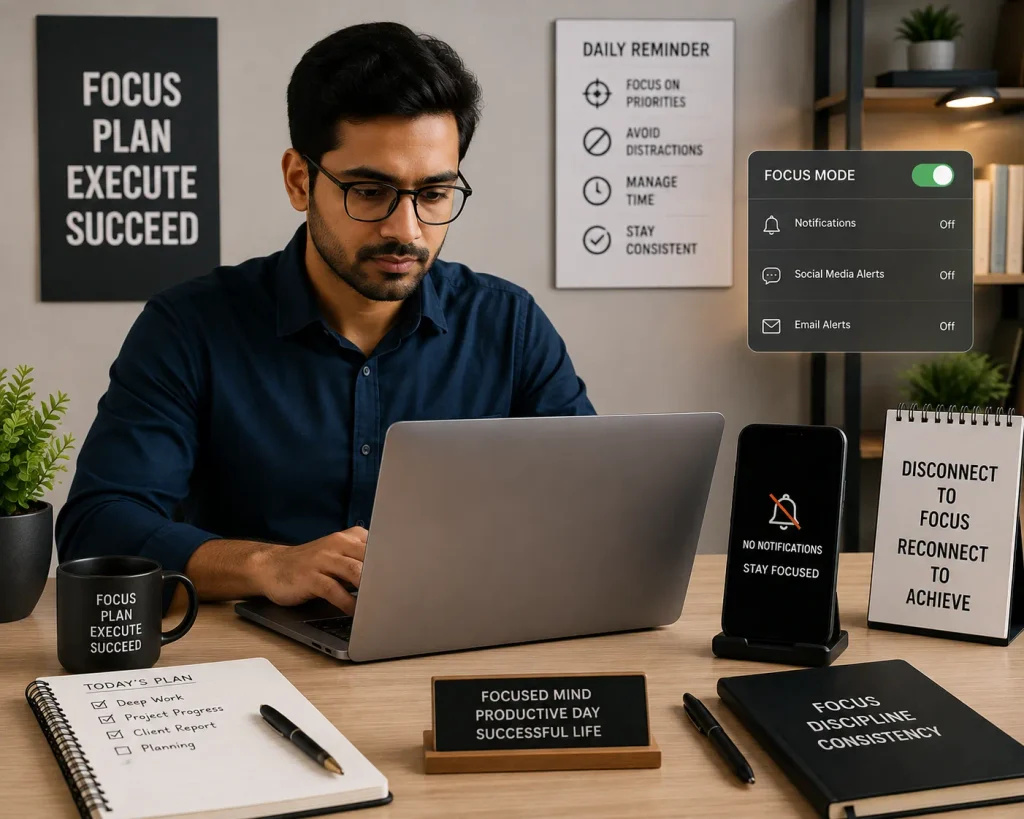
Staying focused can be difficult when there are constant notifications, messages, social media updates, emails, and other interruptions competing for your attention. Even when you have enough time to complete a task, frequent distractions can make the work take much longer.
Learning how to stay focused and avoid distractions is an important skill for students, professionals, business owners, creators, and anyone who wants to manage their time more effectively.
The good news is that better focus does not require working continuously for hours. A better approach is to create an environment that supports concentration, choose clear priorities, and use simple techniques to reduce unnecessary interruptions.
In this guide, we will explore practical ways to improve focus, reduce distractions, and create a more productive daily workflow.
Why Is Staying Focused So Important?
Focus allows you to give your attention to one task at a time.
When you constantly switch between activities, you may spend extra time remembering where you left off and deciding what to do next.
Poor focus can lead to:
- Delayed projects
- More mistakes
- Missed deadlines
- Incomplete tasks
- Increased frustration
- Lower-quality work
Better concentration makes it easier to work through important tasks without repeatedly starting over.
1. Start With One Clear Priority
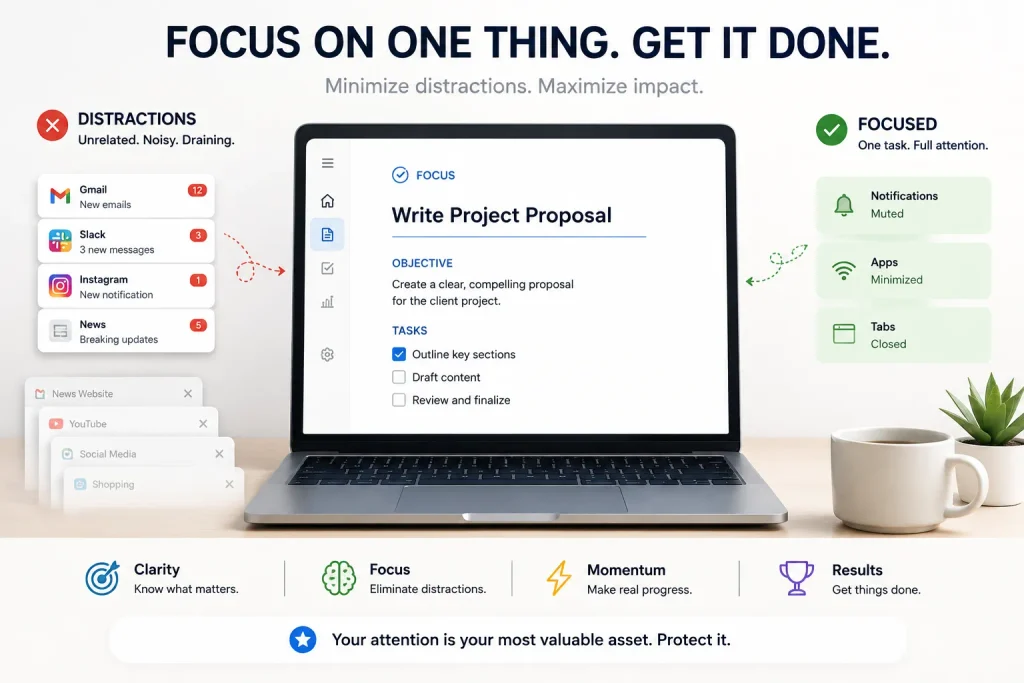
One of the easiest ways to improve focus is to decide what you are working on before you begin.
Instead of starting your day with a long list of unrelated activities, identify your most important task.
Ask yourself:
“What is the most useful thing I can complete right now?”
Once you have an answer, give that task your attention before moving to less important activities.
You can still maintain a larger task list, but your immediate focus should remain clear.
2. Remove Unnecessary Notifications
Notifications are among the most common sources of digital distraction.
Messages, emails, app alerts, and social media notifications can interrupt your concentration.
Consider turning off notifications that are not important.
You can also use:
- Do Not Disturb mode
- Focus mode
- Silent notifications
- Scheduled notification summaries
The goal is not to disconnect from everything. Instead, control when interruptions are allowed to reach you.
3. Keep Your Workspace Simple
Your physical environment can influence your ability to concentrate.
A crowded desk can make it harder to focus on the task in front of you.
Try keeping only the items you need nearby.
A simple workspace might include:
- Computer or laptop
- Notebook
- Pen
- Water
- Required documents
Everything else can be placed somewhere else until it is needed.
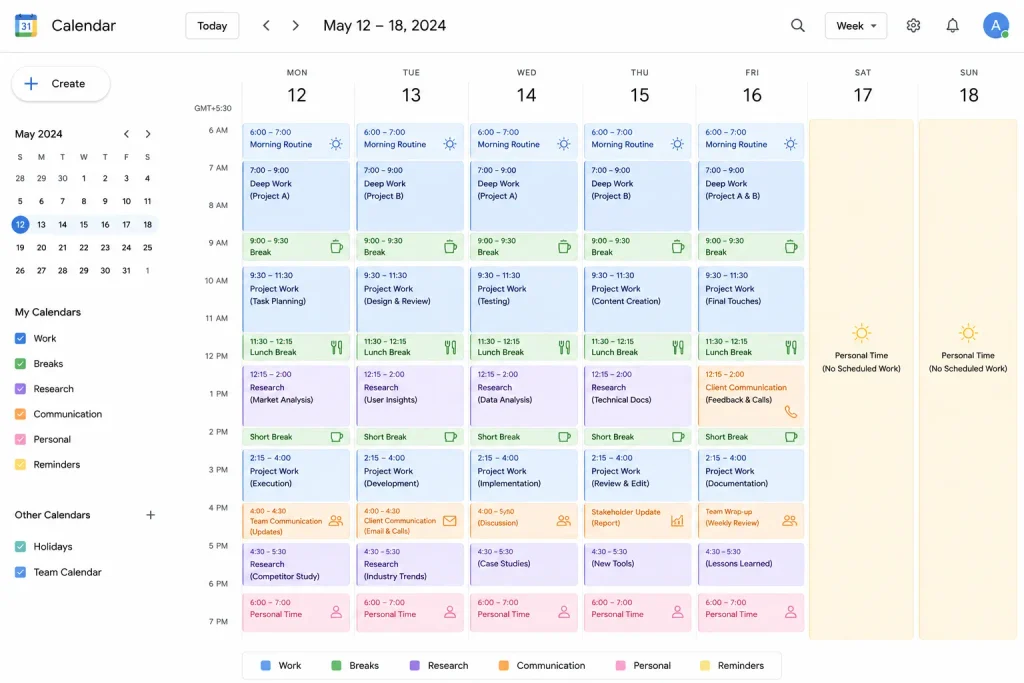
4. Use Time Blocking
Time blocking involves assigning specific periods to specific activities.
For example:
9:00–10:00: Writing
10:00–10:15: Break
10:15–11:15: Research
11:15–11:45: Email
This gives your day structure and makes it easier to protect focused work periods.
You can adjust the length of each block according to your schedule.
5. Try Short Focus Sessions
You do not always need a long uninterrupted session to make progress.
Try working for a short, defined period and then taking a brief break.
For example:
25 minutes of focused work → short break → repeat
Another person may prefer:
45 minutes of focused work → short break
There is no single perfect duration.
Experiment with different time periods and find a rhythm that works well for you.
6. Avoid Multitasking
Multitasking can feel productive because several things appear to be happening at once.
However, constantly switching between unrelated activities can make it harder to maintain concentration.
Instead of:
- Writing an article
- Checking email
- Reading messages
- Browsing websites
at the same time, try completing one focused activity before moving to the next.
Single-tasking creates a clearer workflow.
7. Keep a Distraction List
Sometimes distractions are not external.
You may suddenly remember another task while working.
For example:
- “I need to reply to that message.”
- “I should check this website.”
- “I need to research another topic.”
- “I should organize that document.”
Instead of immediately stopping your current task, write the thought on a distraction list.
Return to it later.
This allows you to capture the idea without allowing it to interrupt your current work.
8. Set Clear Work Boundaries
If other people frequently interrupt you, establish simple boundaries.
For example, you can communicate that you are working on an important task and will respond after your focused work period.
Clear expectations can reduce unnecessary interruptions.
If you work in a shared environment, headphones or a visible “busy” signal may also help communicate that you are concentrating.
9. Control Social Media Usage
Social media can easily turn a short break into a much longer distraction.
If social media is affecting your focus, consider creating specific times for checking it.
For example:
12:30 PM: Social media check
6:00 PM: Social media check
Outside those periods, keep the apps closed or notifications disabled.
The goal is to make social media a planned activity rather than an automatic interruption.
10. Organize Your Browser
When working online, an overloaded browser can become distracting.
You might have dozens of tabs open, including:
- Articles
- Videos
- Social media
- Shopping pages
- Research
- Work documents
Try closing tabs that are not necessary for your current task.
You can also save useful pages for later instead of keeping everything open.
A clean browser can make digital work feel more manageable.
11. Use the Two-Minute Capture Rule
When a new thought appears, quickly capture it rather than immediately acting on it.
Write it in:
- A notebook
- Task manager
- Notes app
- Project list
Then return to your current task.
Later, review your captured items and decide what actually requires action.
This technique is particularly useful when you have many ideas during focused work.
12. Prepare Before You Start
Preparation can reduce distractions before they happen.
Before beginning an important task, collect everything you need.
For example, if you are writing an article, prepare:
- Topic
- Outline
- Research notes
- Keywords
- References
- Images or image ideas
This reduces the need to stop repeatedly to find missing information.
13. Set a Clear End Goal
A vague task can be difficult to focus on.
Compare:
“Work on website.”
with:
“Write the introduction and first three sections of the article.”
The second goal is much clearer.
Specific goals help you understand what completion looks like.
14. Take Meaningful Breaks
Breaks are an important part of maintaining concentration.
A good break gives your attention a chance to reset.
You might:
- Walk around
- Stretch
- Drink water
- Look away from the screen
- Get some fresh air
- Simply relax for a few minutes
Avoid turning every break into a long digital session.
A short break should help you return to your work with a clearer mind.
15. Get Enough Rest
Concentration becomes harder when you are tired.
A consistent sleep routine, regular breaks, and a balanced daily schedule can support better attention.
If you notice that you repeatedly struggle to focus because you are exhausted, improving your overall routine may be more useful than adding another productivity tool.
16. Use Website and App Limits When Helpful
Many devices provide features that allow you to limit access to distracting apps or websites.
These features can help create boundaries during focused work periods.
For example, you might temporarily restrict entertainment or social media applications while working on an important project.
Use these features as support rather than relying entirely on willpower.
17. Create a Distraction-Free Start
The first few minutes of a work session can determine how the rest of the session goes.
Before starting:
- Choose the task.
- Remove unnecessary tabs.
- Silence non-essential notifications.
- Prepare your materials.
- Set a work period.
- Begin immediately.
This creates a predictable starting routine.
18. Review What Distracts You
Not every distraction has the same cause.
At the end of the day, think about what interrupted you most.
Was it:
- Phone notifications?
- Social media?
- Email?
- Other people?
- Unclear tasks?
- Too many browser tabs?
- Lack of preparation?
Once you identify the main source, you can address it directly.
A Simple Focus Routine
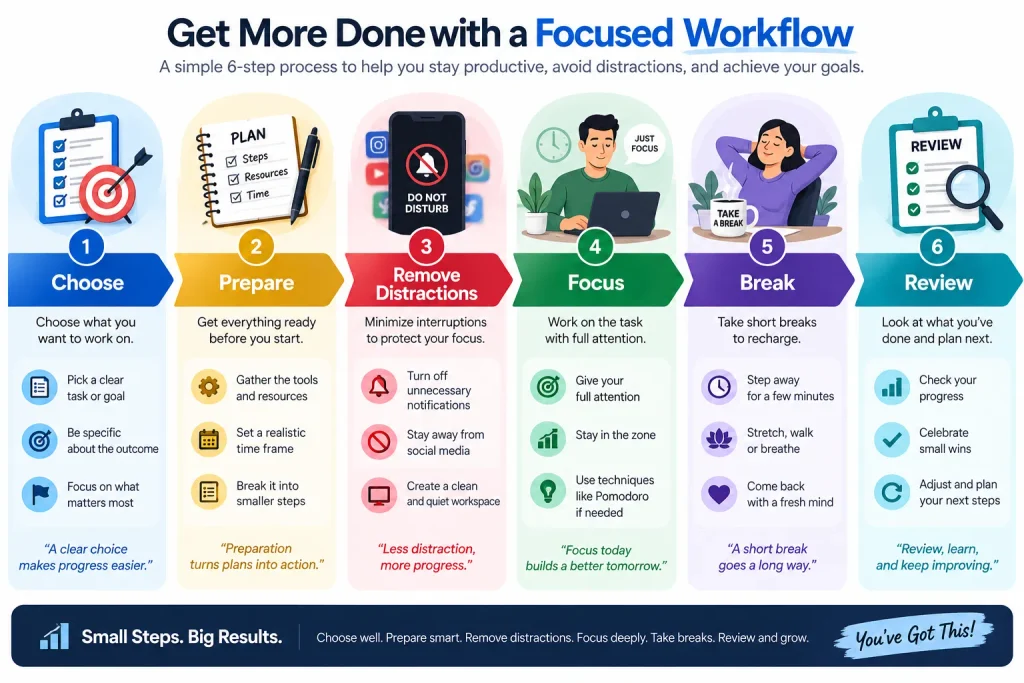
Here is a practical routine you can use:
Step 1: Choose One Task
Select the most important activity.
Step 2: Define the Result
Decide exactly what you want to accomplish.
Step 3: Prepare
Collect the information and tools you need.
Step 4: Remove Distractions
Silence unnecessary notifications and close unrelated applications.
Step 5: Start a Focus Session
Work for a defined period.
Step 6: Take a Short Break
Step away briefly before continuing.
Step 7: Review
Check your progress and decide what comes next.
This simple system can be adjusted to fit different schedules.
Common Focus Mistakes
Checking Your Phone Constantly
Frequent phone checks can break your concentration.
Keeping Too Many Tasks Open
Too many active tasks can make it difficult to decide where to focus.
Working Without a Goal
A vague objective often leads to unnecessary browsing and task switching.
Ignoring Breaks
Working continuously is not always the best approach.
Using Too Many Productivity Systems
Complex systems can become distractions themselves.
Keep your focus strategy simple.
Frequently Asked Questions
How can I stay focused while working?
Choose one clear task, remove unnecessary distractions, set a defined work period, and take short breaks when needed.
What is the biggest cause of digital distraction?
Common causes include notifications, social media, messaging apps, entertainment websites, and unnecessary multitasking.
Is multitasking good for productivity?
For many tasks, focusing on one activity at a time can make the workflow clearer and reduce unnecessary switching.
How long should a focus session be?
There is no universal answer. Some people prefer shorter sessions, while others work comfortably for longer periods. Choose a duration that you can maintain effectively.
How can I stop checking my phone while working?
Turn off non-essential notifications, keep the phone away from your immediate workspace, and create specific times for checking messages.
Conclusion
Learning how to stay focused and avoid distractions is less about forcing yourself to concentrate and more about creating an environment that makes concentration easier.
Start by choosing clear priorities, reducing unnecessary notifications, organizing your workspace, and working in defined focus sessions.
Techniques such as time blocking, task capture, single-tasking, distraction lists, and meaningful breaks can help create a more consistent workflow.
You do not need a complicated productivity system. Small changes can make a significant difference when you apply them consistently.
The goal is to spend more time on meaningful work and less time reacting to every interruption that appears throughout the day.


